
Table of Contents
If you have astigmatism, you already know the frustration. Blurry vision at every distance. Halos around lights at night. Headaches after long hours of screen time. And the constant adjustment of glasses that just never feel quite right.
Here is the good news: millions of people with astigmatism now wear contact lenses comfortably every single day. Technology has come a long way.
If you are a first-time wearer, this guide will walk you through everything you actually need to know that makes the difference between giving up on contacts and never looking back.
What Is Astigmatism, and Why Does It Make Contacts Trickier?
Your eye is supposed to be shaped like a perfect sphere like a basketball. In astigmatism, the eye is shaped more like a football. This irregular curve means light hits the retina at more than one point, causing blurred or distorted vision.
According to the American Optometric Association, astigmatism affects approximately 1 in 3 people in the United States. It often exists alongside nearsightedness or farsightedness, making vision correction a two-part challenge.
Standard contact lenses are round and sit symmetrically on the eye. That works fine for simple prescriptions. But with astigmatism, a standard lens can rotate on your eye and blur your vision in seconds. This is exactly why you need a contact lens for astigmatism, specifically designed to stay in place and correct that irregular curve precisely.
What Makes a Contact Lens for Astigmatism Different?
The lens designed for astigmatism is called a toric lens. Unlike regular lenses, toric lenses have two different powers built into one lens — one for astigmatism correction, one for nearsightedness or farsightedness if needed.
They also have a stabilization system. This keeps the lens from rotating when you blink or move your eyes. Different brands use different stabilization methods — some use a thicker zone at the bottom of the lens, others use pressure zones on the sides. The goal is the same: keep the lens oriented correctly so your vision stays sharp.
Quick Fact: Toric lenses take slightly longer to settle on the eye after each blink compared to regular lenses. This is completely normal and not a sign that something is wrong.
How Do You Find the Best Contact Lens for Astigmatism?
This is where first-time wearers get confused. You search online, you see dozens of brands, and every one of them claims to be the best. The truth is: what is the best contact lens for astigmatism depends entirely on your specific eye shape, prescription, and lifestyle.
There are a few key factors your eye doctor will evaluate:
1. Your prescription strength (cylinder and axis)
Astigmatism prescriptions include a cylinder power and an axis number. The higher the cylinder, the more correction you need — and not every lens handles high cylinders well.
2. Your eye’s surface curvature (base curve)
Toric lenses come in different base curves. A lens that fits one person perfectly may sit too flat or too steep on another person’s eye. Poor fit means blurry vision, discomfort, or the lens falling out.
3. Daily vs. monthly lenses
Daily toric lenses are great for beginners. You open a fresh pair each day — no cleaning, no storage, no buildup. Monthly lenses are more economical over time but require a consistent care routine.
4. Lens material and oxygen permeability
Your cornea needs oxygen to stay healthy. Modern silicone hydrogel toric lenses allow significantly more oxygen through compared to older materials. This matters especially if you wear lenses for long hours.
According to the National Eye Institute, wearing lenses that do not allow sufficient oxygen can increase the risk of corneal complications over time. This is a reason why the lens material in your prescription matters — not just the power.
What About Colored Contact Lens for Astigmatism?
Yes, they exist. And yes, they work.
A colored contact lens for astigmatism is a toric lens that also changes or enhances your eye color. They follow the same stabilization design as clear toric lenses — they just have a color layer added.
Here is what first-time wearers should know about colored contact lens for astigmatism:
- Fit is even more important. Because the colored zone needs to align correctly with your iris, any rotation affects both vision and appearance.
- Color choices may be limited compared to regular colored lenses, since not every brand makes toric versions in their full color range.
- Prescription accuracy is non-negotiable. Never buy colored contact lens for astigmatism from a retailer that does not require a valid prescription. This is not just a legal requirement in the U.S. — it is a safety one.
The FDA regulates all contact lenses as medical devices, including cosmetic and colored ones. Purchasing lenses without a prescription, even purely cosmetic ones, is illegal and can cause serious eye damage including corneal ulcers and permanent vision loss.
Tip: If you want to try colored lenses, ask your eye doctor to include this in your fitting. They can recommend brands that make toric versions in colors that suit your natural eye tone.
The Contact Lens Fitting: What Actually Happens?
A regular eye exam and a contact lens fitting are two different appointments. Many first-time wearers don’t realize this.
During a contact lens fitting, your doctor does not just verify your prescription. They measure your corneal curvature using a keratometer or corneal topographer. They check your tear film quality because dry eyes and contact lenses do not mix well without the right lens choice. They assess your pupil size and iris diameter.
Then they put a trial lens on your eye. You wear it for several minutes. They check how it moves, how it centers, and how your vision is with it on. They may try two or three different brands before finding the right match.
This process is why you cannot simply order a contact lens for astigmatism online based on your glasses prescription. The numbers are different, and the fit is a physical assessment that requires a trained eye care professional.
What Should First-Time Wearers Realistically Expect?
Let’s be honest about the first few weeks.
Week 1: Your eyes may feel dry or slightly irritated. You might notice the lens at first. Your vision may fluctuate slightly as the lens settles on your eye. This is all normal.
Week 2–3: Most people adapt. The lens starts to feel natural. Vision stabilizes. You stop noticing it in your eye.
Month 1+: If things are still uncomfortable or your vision is inconsistently clear, go back. Toric lens fitting sometimes requires adjustment. A different brand, a different base curve, or a different material may solve it entirely.
Tip: Do not extend the wear time of your lenses beyond what is prescribed. Overwearing toric lenses, even by a few hours, increases the risk of corneal oxygen deprivation, inflammation, and infection. Follow your doctor’s schedule exactly.
Are There Any Vision Problems Contacts Cannot Fix?
Contact lenses correct the refractive error caused by astigmatism. They do not treat the underlying eye structure. If your astigmatism is irregularly caused by a condition like keratoconus, standard toric lenses may not give you adequate vision correction.
In those cases, your doctor may recommend specialty lenses such as rigid gas-permeable (RGP) lenses or scleral lenses, which vault over the corneal surface entirely and create their own smooth optical surface with the tear fluid underneath.
This is exactly why a proper contact lens eye exam matters before any purchase. It is not just about getting numbers on a prescription, it is about understanding what type of lens your eye can safely and effectively use.
What Is the Best Contact Lens for Astigmatism by Lifestyle?
There is no single universal answer to what is the best contact lens for astigmatism — but here is a practical breakdown:
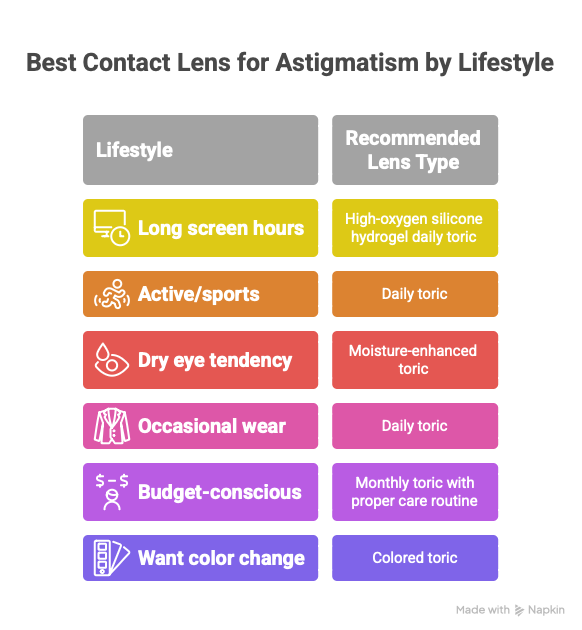
Your eye doctor will guide you toward the right category once they assess your eyes. Do not skip the fitting to save time, it saves you months of discomfort and failed trial-and-error later.
Where to Get Your Lenses and Prescription Filled
Once your fitting is complete and your prescription is finalized, you have options. You can fill your prescription at eyeglass & contact lens stores that carry a wide range of toric brands, this gives you the advantage of in-person guidance and brand availability in one place.
Always ensure the store requires your valid prescription before dispensing. A legitimate provider whether a clinic or an eyeglass & contact lens store, will not sell toric lenses without one. If a retailer offers to skip this step, walk away.
Key Takeaways
- Astigmatism affects roughly 1 in 3 Americans and requires specially designed toric lenses for contact lens correction.
- Toric lenses have built-in stabilization to prevent rotation — this is what makes them different from regular lenses.
- A contact lens fitting is a separate appointment from a regular eye exam and is essential before wearing toric lenses.
- Colored toric lenses exist and are FDA-regulated medical devices — always buy with a valid prescription.
- The best contact lens for astigmatism depends on your corneal shape, prescription strength, tear film, and lifestyle — not brand popularity.
- Discomfort in the first two weeks is normal. Persistent discomfort after that needs a follow-up.
- Specialty lenses like scleral or RGP lenses exist for irregular astigmatism cases.
Conclusion
Contact lenses for astigmatism have never been more effective, more comfortable, or more accessible than they are right now. Whether you are looking for clear daily lenses, high-performance monthly options, or even a colored contact lens for astigmatism that lets you change your look without compromising your vision, the right option exists for you.
The single most important step is getting a proper contact lens fitting with an experienced eye doctor who understands toric lens technology and your specific eye anatomy. That one appointment changes everything.
At Southwest Florida Eye Care, our team of optometrists and ophthalmologists specializes in contact lens fittings for patients with astigmatism across Fort Myers, Cape Coral, and Naples, FL. We take the time to find the lens that fits your eyes, your prescription, and your life, not just the closest generic option.
Frequently Asked Questions
Can I sleep in toric contact lenses for astigmatism?
Most toric lenses are not approved for overnight wear. Sleeping in any lens that is not specifically labeled as extended-wear increases the risk of corneal infection and oxygen deprivation significantly. Always check your lens packaging and ask your doctor before attempting overnight wear.
Why does my vision go blurry for a second when I blink while wearing toric lenses?
Toric lenses need a brief moment to re-stabilize after each blink. A quick flash of blur followed by clear vision is normal, especially in the first few weeks. If the blur lasts more than a second or two consistently, your lens fit may need adjustment.
Can children and teenagers wear contact lenses for astigmatism?
Yes. The American Academy of Ophthalmology notes that contact lens candidacy is based more on maturity and responsibility than age. Teenagers who demonstrate consistent hygiene habits are generally good candidates. A fitting and proper instruction session are essential regardless of age.
Will my astigmatism get worse if I wear contact lenses?
No. Contact lenses do not change the shape of your eye or cause astigmatism to worsen. They simply correct the refractive error while worn. Astigmatism progression, if it occurs, is driven by natural eye development — not lens use.
How often do I need to update my contact lens prescription for astigmatism?
Most eye doctors recommend an annual contact lens eye exam to check that your prescription is current and that your eyes remain healthy for lens wear. Your prescription can change gradually, and an outdated prescription may give you suboptimal vision even with a well-fitted lens.
Still wondering which contact lens is right for your eyes?
That answer starts with one conversation with the right eye care team.
Ready to see clearly and comfortably for the first time? Contact us today to schedule your contact lens fitting because good vision should never feel like a compromise.