Table of Contents
Have you ever wondered why millions of people every year are ditching their glasses and contact lenses for good and never looking back?
LASIK eye surgery has been changing lives for over three decades. But here is what most people do not know: the LASIK performed today looks almost nothing like the procedure from even five years ago. The technology has advanced so rapidly that what was once considered risky or out of reach for many patients is now safer, faster, and more precise than ever before.
Whether you have been thinking about LASIK for years or just started exploring your options, this guide will walk you through everything from how the procedure works to the very latest innovations reshaping laser eye surgery in 2026.
By the end, you may find yourself asking not if LASIK is right for you, but when.
What Is LASIK Surgery?
LASIK — short for Laser-Assisted In Situ Keratomileusis is a refractive eye surgery that reshapes the cornea to correct how light focuses on the retina. It is one of the most commonly performed elective surgeries in the United States, with over 700,000 procedures performed annually, according to the American Academy of Ophthalmology.
So, what is the newest laser eye surgery technology? The answer starts with understanding what LASIK actually does and how far it has come.
How LASIK Works
A surgeon creates a thin flap on the outer surface of the cornea using either a microkeratome blade or, in modern procedures, a femtosecond laser. The flap is gently lifted, and an excimer laser precisely removes microscopic amounts of corneal tissue to reshape it. The flap is then repositioned, where it naturally bonds without stitches. The entire procedure typically takes under 15 minutes per eye.
Conditions It Treats
LASIK is FDA-approved to correct:
- Myopia (nearsightedness) — difficulty seeing objects at a distance
- Hyperopia (farsightedness) — difficulty seeing objects up close
- Astigmatism — blurred vision caused by an irregularly shaped cornea
According to the National Eye Institute, approximately 11.1 million Americans have vision impairment that could potentially benefit from refractive correction like LASIK.
Evolution of LASIK Technology
The LASIK of 1999 and the LASIK of 2026 share the same name but very little else.
Is LASIK technology improving in 2026? Absolutely, and the evolution has been extraordinary.
From Blade to Bladeless LASIK
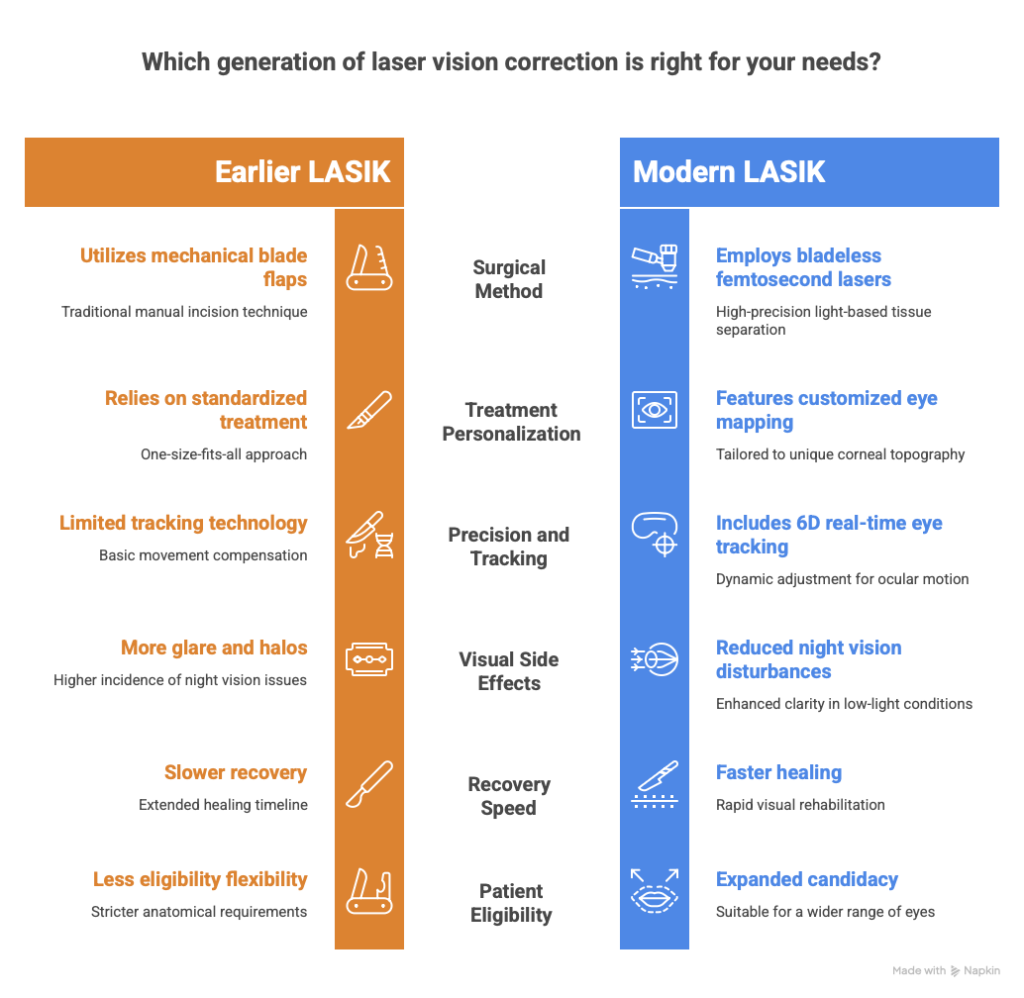
LASIK, or Laser-Assisted In Situ Keratomileusis, has undergone an impressive metamorphosis since its inception. Introduced in 1989 by Dr. Gholam Peyman to reshape the cornea and correct refractive errors, LASIK has transcended its early stages and entered a new era defined by precision, safety, and personalized care. The first publication ever produced about using laser vision correction in patient care was by Dr. Ioannis Pallikaris in the early 1990s.
Read Also: Preparing for LASIK: Dos and Don’ts Before Your Surgery
Rise of Femtosecond Lasers
Femtosecond lasers fire pulses measured in quadrillionths of a second. This speed allows surgeons to make cuts so precise that surrounding tissue is left completely undisturbed. Platforms like the IntraLase, ZEISS VisuMax, and Alcon WaveLight systems have set new benchmarks for flap accuracy and patient safety. Bladeless procedures now account for the overwhelming majority of LASIK surgeries performed in accredited U.S. clinics.
Latest LASIK Advancements
This is where it gets truly exciting. What are the latest advancements in LASIK surgery? The answer involves artificial intelligence, advanced eye mapping, and real-time tracking systems that were pure science fiction just a decade ago.
Wavefront & Topography-Guided LASIK
What is wavefront-guided LASIK? It is a customized form of LASIK that uses detailed 3D mapping of your eye’s unique imperfections, called higher-order aberrations, to guide the laser with extreme precision. Traditional LASIK corrected the basic prescription. Wavefront-guided LASIK corrects up to 1,200 data points across the entire optical surface of your eye.
Topography-guided LASIK takes this a step further by mapping the exact curvature of the corneal surface.
Pro Tip: If you have irregular corneas or have had poor results with traditional vision correction, ask your surgeon specifically about topography-guided LASIK. It may be the option that was not available to you before.
AI-Driven Eye Mapping
Artificial intelligence is now embedded into pre-surgical planning. AI algorithms analyze thousands of data points from corneal scans, pupil measurements, and refractive error measurements to build a surgical plan unique to each patient’s eye. This reduces human error and adds a layer of precision that even the most experienced surgeons cannot achieve manually.
Is LASIK technology improving in 2026? AI is a major reason the answer is yes.
Real-Time Eye Tracking Systems
Even the most cooperative patient’s eye moves involuntarily during surgery. Modern excimer laser platforms now use 6D eye tracking, tracking not just left-right and up-down movement, but also rotational shifts and z-axis (depth) variation. The laser automatically adjusts its aim hundreds of times per second, ensuring every pulse lands exactly where it was intended. This technology has dramatically reduced the margin of human and mechanical error.
Benefits of Modern LASIK
Modern LASIK surgery offers significantly better outcomes than procedures performed even five years ago. Thanks to wavefront-guided treatment, AI-assisted planning, and femtosecond laser precision, today’s patients experience higher accuracy, faster healing, and fewer complications.
How safe is modern LASIK surgery? The answer lies directly in these measurable, technology-driven improvements that now define the standard of care across accredited U.S. eye surgery centers.
Higher Accuracy and Customization
No two eyes are identical. Modern LASIK platforms treat your eye like a fingerprint, completely individual. Custom wavefront plans, AI mapping, and real-time tracking combine to deliver results that were simply not achievable with earlier technology.
Faster Recovery Time
Most patients see clearly within 24 to 48 hours of surgery. Many return to work and normal activities the very next day. Compare this to older procedures where recovery could take a week or more.
How long does LASIK recovery take in 2026? For the majority of patients, less than 48 hours for functional vision and two to four weeks for complete stabilization.
Reduced Side Effects
Older LASIK patients frequently reported halos, glare, and starbursts — especially at night. Advanced wavefront correction and AI-optimized treatment plans have significantly reduced these side effects.
Studies published through the American Refractive Surgery Council show that side effects are reported far less frequently with modern platforms than with first-generation LASIK systems.
LASIK vs. SMILE vs. PRK
What is the newest laser eye surgery technology beyond traditional LASIK? Two major alternatives deserve attention.
Key Differences
| Procedure | Flap Created? | Recovery | Best For |
| LASIK | Yes | 24–48 hrs | Most prescriptions |
| SMILE | No | 3–7 days | Myopia, dry eye-prone |
| PRK | No | 5–7 days | Thin corneas, active lifestyles |
SMILE (Small Incision Lenticule Extraction) is a newer, flapless procedure that removes a tiny disc of corneal tissue through a small incision. Because no flap is created, it is preferred for patients with dry eye concerns or those in contact sports.
PRK (Photorefractive Keratectomy) removes the corneal surface layer entirely before reshaping — recovery is longer, but it is ideal for patients with thin corneas who are not LASIK candidates.
Which Is Best for You?
There is no universal answer.
A comprehensive consultation with a qualified ophthalmologist, including corneal thickness measurements, dry eye testing, and wavefront analysis, is the only way to determine your ideal procedure.
Who Is Eligible for LASIK Today?
Not everyone who wants LASIK automatically qualifies but thanks to rapid advances in diagnostic technology and surgical planning, significantly more patients are eligible in 2026 than ever before.
Ideal LASIK candidates are adults over 18 with a stable prescription for at least one to two years, adequate corneal thickness, and no active eye disease. However, expanded screening tools now allow surgeons to evaluate borderline cases with far greater accuracy, opening the door for patients who may have been turned away in the past.
Expanded Eligibility — Thin Corneas and Dry Eye Improvements
One of the most significant shifts in modern LASIK is who qualifies. Patients previously turned away for thin corneas or mild dry eye may now be candidates thanks to topography-guided planning, newer laser platforms that remove less tissue, and pre-treatment protocols for dry eye management. Your surgeon can now assess candidacy with a level of detail that simply was not possible before.
When LASIK Is Not Recommended
LASIK remains contraindicated for patients with:
- Keratoconus or other progressive corneal conditions
- Severe, uncontrolled dry eye disease
- Unstable prescriptions (vision still changing year to year)
- Certain autoimmune disorders
Patients under 18 or with very high prescriptions beyond the laser’s treatment range may also be advised to consider alternatives.
Risks and Safety Considerations
How safe is modern LASIK surgery? According to the FDA, LASIK is one of the safest elective procedures available, but like all surgeries, it carries risk.
Common Side Effects
- Temporary dry eye (most common, usually resolves within 3–6 months)
- Mild halos or glare at night (typically improves within weeks)
- Under or over-correction (addressable with an enhancement procedure)
Long-Term Safety Insights
A landmark study published in JAMA Ophthalmology found that the vast majority of LASIK patients report no significant long-term complications. Serious complications, such as vision loss, occur in fewer than 1 in 1,000 patients, making it statistically safer than long-term contact lens wear, which carries a cumulative infection risk over years of use.
Quick Fact: The FDA has approved LASIK for over 25 years. Millions of procedures are performed worldwide each year with an established long-term safety record.
Future of Laser Eye Surgery
The future of laser eye surgery is nearer than most people think. As technology continues to evolve rapidly, researchers and surgeons are developing tools that go far beyond what today’s LASIK platforms can do.
From fully automated surgical planning to procedures that correct age-related vision changes, the next generation of laser eye surgery is being built around one goal: giving every patient the most precise, personalized vision correction possible.
What is the newest laser eye surgery technology on the horizon? The answer points squarely toward artificial intelligence and individualized treatment models that adapt to each patient’s unique biology, not just their prescription.
AI Integration
The next frontier is fully AI-automated surgical planning and, eventually, AI-assisted real-time laser adjustment during surgery. Several platforms already in clinical trials use machine learning to predict healing patterns and adjust treatment dosing accordingly, meaning the laser does not just treat what your eye looks like now, but anticipates what it will look like after healing.
Personalized Vision Correction
Surgeons are beginning to explore presbyopia-correcting LASIK procedures that adjust the cornea to create a multifocal effect, reducing the need for reading glasses in older patients. This is still evolving, but early results are promising.
Key Takeaways
- Modern LASIK uses femtosecond lasers, wavefront mapping, AI planning, and 6D eye tracking for unmatched precision
- Over 96% of LASIK patients report satisfaction with their results
- Recovery in 2026 is typically 24–48 hours for functional vision
- Expanded eligibility means more patients qualify today than ever before
- SMILE and PRK are strong alternatives, depending on corneal health and lifestyle
- Serious complications occur in fewer than 1 in 1,000 cases
Final Thoughts: Is LASIK Still Worth It?
In 2026, LASIK is not just still worth it — it is better than it has ever been. The combination of wavefront-guided precision, AI-driven planning, femtosecond flap creation, and real-time tracking has transformed a once-pioneering procedure into a refined, highly predictable science.
What are the latest advancements in LASIK surgery? You have now seen the full picture — from bladeless flap creation to AI eye mapping to 6D tracking. Is LASIK technology improving in 2026? Without question. And how safe is modern LASIK surgery? Safer than it has ever been in its history.
The real question now is: are you ready to see the world without glasses?
Frequently Asked Questions
What is the success rate of modern LASIK surgery?
Clinical data consistently show that over 96% of LASIK patients achieve their target vision, with very high satisfaction rates reported in peer-reviewed studies.
What is bladeless LASIK, and is it better?
Bladeless LASIK uses a femtosecond laser instead of a mechanical blade to create the corneal flap. It offers greater precision, more uniform flap thickness, and a reduced risk of flap-related complications compared to traditional blade-based LASIK.
Can LASIK treat severe vision problems?
LASIK is FDA-approved for a broad range of prescriptions, but extremely high prescriptions may exceed the treatable range. In those cases, procedures like implantable collamer lenses (ICL) may be recommended as an alternative.
How long does LASIK recovery take in 2026?
Most patients achieve functional, clear vision within 24 to 48 hours. Full visual stabilization typically occurs over two to four weeks, though some subtle changes may continue for up to three months.
What are the alternatives to LASIK?
The primary alternatives include SMILE (Small Incision Lenticule Extraction), PRK (Photorefractive Keratectomy), and ICL (Implantable Collamer Lens). The right choice depends on corneal thickness, prescription strength, dry eye status, and lifestyle factors — all assessed during a comprehensive consultation.
Are You Ready to Find Out If LASIK Can Change Your Life?
At Southwest Florida Eye Care, our experienced team serves patients across Fort Myers, Cape Coral, and Naples, Florida, using the most advanced LASIK technology available today. We offer comprehensive LASIK consultations to determine whether you are a candidate and, if so, which procedure is the best fit for your eyes and your life.
Contact us for more information on how Southwest Florida Eye Care continues to use LASIK to transform patient care.