Table of Contents
Glasses and contact lenses are common ways for people with vision problems to see more clearly. However, more serious issues may require eye surgery, such as cataracts.
Cataracts are a medical condition caused by the clouding of the ocular lens, which is normally clear. Like looking through a frosted window, the obstructed visual acuity interferes with routine activities like reading, driving, or identifying faces.
Cataract surgery, which removes the cloudy cataract to help you see well again, is the only option to regain clear sight once cataracts develop. Read more to learn about the innovative procedure and the benefits of laser cataract surgery.
What is Laser Cataract Surgery?
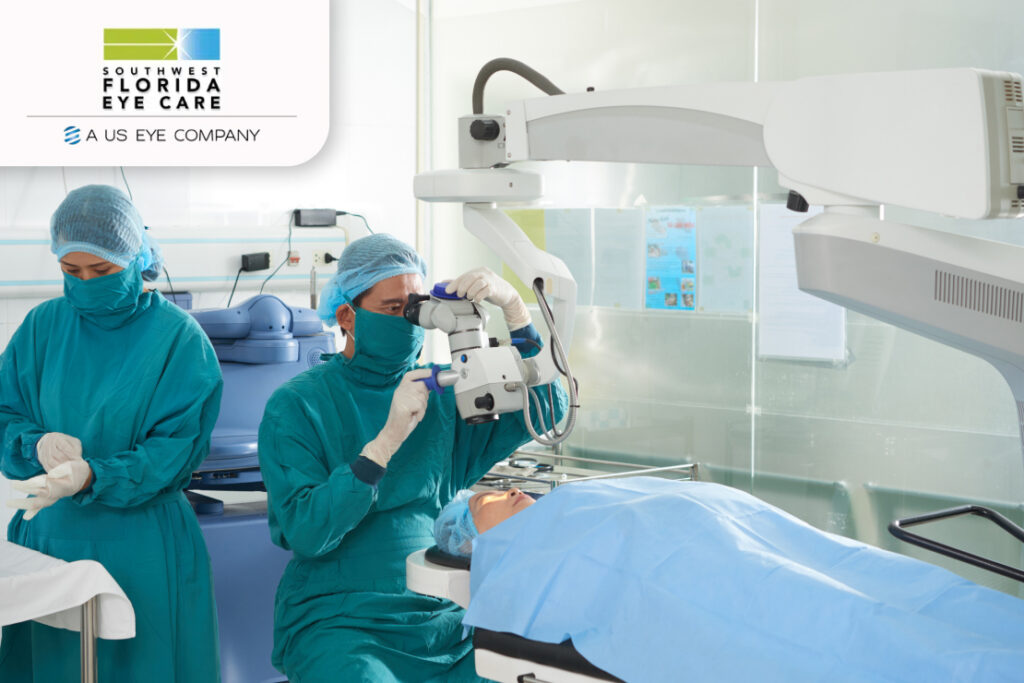
Laser cataract surgery, as performed at Southwest Florida Eye Care, is an advanced procedure designed to help people suffering from clouded vision due to cataracts regain clarity in their sight. Utilizing state-of-the-art laser technology allows for more precise incisions, ensuring improved accuracy and consistency.
As part of the procedure, your natural lens, clouded by the cataract, is carefully removed and replaced with an artificial one called an intraocular lens (IOL) implant.
How the Procedure Works
Before surgery begins, your eye is mapped using optical coherence tomography (OCT) — a 3D imaging system that measures your eye’s exact dimensions. This data is then used to program the laser, ensuring precise incisions, softening of the cataract, and the creation of an opening in the lens capsule (called a capsulotomy) with sub-millimeter accuracy.
The clouded natural lens is then gently broken apart, removed, and replaced with an artificial intraocular lens (IOL) — a clear implant that restores your vision.
Quick Fact: The femtosecond laser used in cataract surgery is the same technology used in LASIK, one of the most studied and proven tools in modern eye care.
Read the blog Preparing for Laser Cataract Surgery: What to Expect for more information on the laser cataract surgical process.
Benefits of Laser Cataract Surgery
So, is laser cataract surgery worth it? For many patients, the answer is yes — especially those who want the best possible visual outcome after surgery. Here is why.
Higher Precision with Femtosecond Lasers
The biggest advantage of laser cataract surgery is accuracy. The femtosecond laser creates incisions that are cleaner and more consistent than what a human hand can achieve with a blade. According to the American Academy of Ophthalmology, early studies showed that laser-assisted capsulotomy produced the intended refractive outcome at six months at a rate four times higher than manual capsulotomy in comparable cases.
This level of precision matters most when premium intraocular lenses are being implanted. A perfectly centered lens placement is critical for the lens to work as designed.
Tip: If you are choosing a multifocal or toric IOL, ask your doctor whether laser assistance is recommended. Precise placement is key to getting the full benefit from premium lenses.
Faster Recovery and Minimal Discomfort
Because the laser softens the lens before removal, less ultrasound energy is needed during surgery. This means less stress on the delicate cells inside your eye. Patients who undergo laser cataract surgery often report less inflammation and faster visual recovery in the days immediately following the procedure.
Most people return to light daily activities within 24 to 48 hours. Full recovery typically happens within four to six weeks.
Ability to Correct Astigmatism During Surgery
One major advantage that traditional cataract surgery does not always offer is the ability to correct astigmatism at the same time. The laser can make precise relaxing incisions in the cornea to reduce or eliminate astigmatism, improving your vision even further. For patients who have been wearing glasses for astigmatism for years, this can be a life-changing benefit.
Risks and Limitations You Should Know
No surgical procedure is risk-free. Before asking who is a good candidate for laser cataract surgery, it is important to understand the potential downsides too.
Potential Complications
According to a review published by the National Institutes of Health, possible complications of laser cataract surgery include a temporary rise in intraocular pressure, mild inflammation inside the eye, and, in rare cases, an irregular capsulotomy opening. Most of these complications are uncommon and manageable by an experienced surgeon.
Complications like macular edema (swelling at the back of the eye) and infection are rare but possible with any type of cataract surgery.
Quick Fact: Both laser and traditional cataract surgery have similar overall complication rates, according to a 2024 assessment by the American Academy of Ophthalmology.
Not Suitable for Every Patient
Laser cataract surgery is not for everyone. Patients with very small pupils, certain corneal conditions, or advanced cataracts that have become very dense may not be good candidates. The laser requires the eye to be docked to the system, which can be difficult in some anatomical situations.
Your surgeon will evaluate your specific eye anatomy during a pre-surgery consultation to determine whether laser assistance is appropriate for you.
Cost Considerations
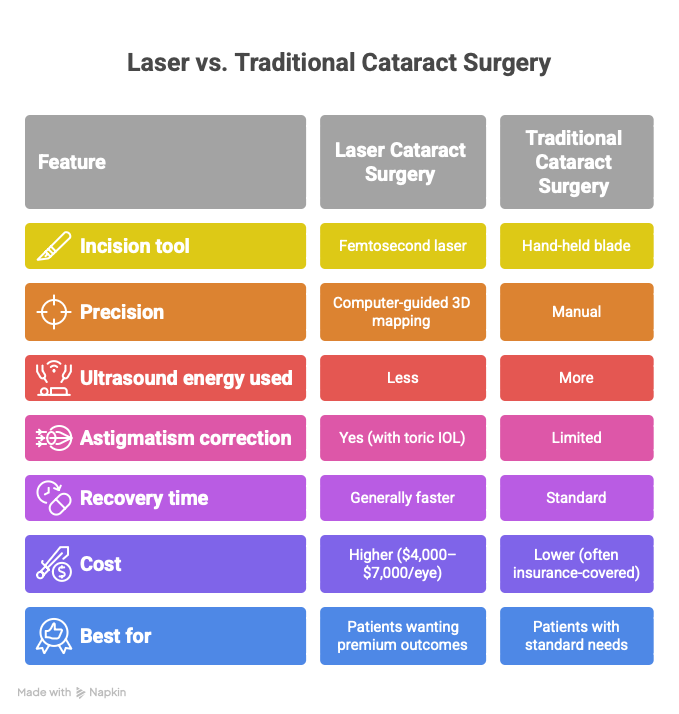
This is one area where laser cataract surgery vs. traditional cataract surgery shows a clear difference. Traditional cataract surgery with a standard monofocal lens is typically covered by Medicare and most private insurance plans. Laser-assisted cataract surgery is generally considered an elective upgrade. Patients can expect to pay an additional $1,500 to $6,000 per eye out of pocket for the laser technology and premium lens upgrades.
The good news: HSA (Health Savings Account) and FSA (Flexible Spending Account) funds can often be used to cover these costs.
Laser Cataract Surgery vs Traditional Cataract Surgery
In traditional cataract surgery, the surgeon uses a hand-held blade to make incisions and manually breaks up the lens using ultrasound energy (phacoemulsification). It is safe and widely performed, but it relies heavily on the surgeon’s individual skill and real-time judgment.
Laser cataract surgery automates the most critical steps, reducing variability and ultrasound energy used. Less ultrasound energy means less trauma to surrounding tissue, which matters significantly for healing.
Accuracy and Outcomes
When comparing laser cataract surgery and traditional cataract surgery, accuracy is where the laser shines. The 3D mapping and computer-guided incisions reduce human variability and improve lens centering. For patients choosing premium IOLs, this precision directly impacts how well the lens performs.
Recovery Time Comparison
Both procedures have similar recovery timelines overall. However, patients undergoing laser cataract surgery often notice less inflammation in the first week due to the reduced ultrasound energy. Driving is typically possible within 1 to 2 days, though your doctor will provide specific guidance.
Cost vs. Value
Is laser cataract surgery safer than manual? Research suggests complication rates are comparable between the two methods. So the value of laser surgery often comes down to precision and premium lens outcomes rather than safety alone. For patients with astigmatism or those choosing multifocal lenses, the added cost may be well worth it.
What Are My Laser Cataract Surgery Options?
Depending on your vision goals and preferences, you may have different options for laser cataract surgery. Below are some common options offered by Southwest Florida Eye Care.
Advanced Vision
Advanced Vision is ideal for those seeking complete freedom from glasses, offering clear vision for all distances, from close-up tasks to far-off sights. The operation involves several steps:
- Cataract laser surgery
- Advanced IOL implant
- Astigmatism treatment
- Corneal topography
- LASIK enhancement (when necessary)
Custom Vision
Custom Vision is a great choice for those who don’t mind wearing glasses for close-up tasks but desire improved distance vision. The process involves:
- Cataract laser surgery
- Astigmatism treatment
- Shape-matched implant
- Corneal topography
- LASIK enhancement (if necessary)
Basic+ Vision
For those primarily focused on a cataract removal procedure to improve overall clarity, Basic+ Vision may be the best fit. Patients choosing this option will still require eyeglasses after surgery. The procedure entails:
- Manual cataract surgery
- Corneal topography
- Shape-matched implants
Who Is a Good Candidate For Laser Cataract Surgery?
Who is a good candidate for laser cataract surgery? This is one of the most important questions to ask your eye doctor. Let’s understand it in detail.
Ideal Age and Condition
Laser cataract surgery is most beneficial for patients in their 50s, 60s, and 70s who have moderate cataracts that are affecting daily life but have not yet become too dense. Patients who are highly motivated to reduce or eliminate their dependence on glasses are also strong candidates.
Eye Health Factors
Good candidates typically have:
- Moderate cataracts with no other major eye diseases (such as advanced glaucoma or macular degeneration)
- A stable prescription
- Interest in premium IOLs (multifocal or toric lenses)
- Astigmatism that they would like corrected at the time of surgery
Tip: Always get a comprehensive pre-surgical eye evaluation. The right procedure for you depends entirely on your unique eye anatomy and vision goals.
Latest Advancements in Cataract Surgery
The field of cataract surgery has changed dramatically in recent years, and it continues to evolve. Here is what is making a real difference today.
Micro-Incision Techniques
Modern laser systems allow surgeons to make smaller, more precise incisions than ever before. Smaller incisions mean faster healing, less risk of infection, and reduced surgically-induced astigmatism.
AI-Assisted Precision
Artificial intelligence is now being integrated into pre-surgical planning for cataract procedures. AI algorithms analyze detailed imaging data from your eye to help surgeons select the optimal lens power and position, improving your predicted refractive outcome after surgery. This is especially valuable when selecting among the many premium IOL options available today.
Premium Intraocular Lenses
Today’s premium IOLs go far beyond the basic monofocal lenses of the past. Options include:
- Toric IOLs — correct astigmatism
- Multifocal IOLs — provide clear vision at multiple distances, reducing the need for reading glasses
- Extended Depth of Focus (EDOF) IOLs — offer a continuous range of vision with fewer halos or glare
- Light Adjustable Lenses (LAL) — can be fine-tuned with UV light up to weeks after surgery for a truly customized result
What to Expect Before, During, and After Surgery
Many patients want to know exactly what happens before, during, and after laser cataract surgery and that is a smart question to ask. The process is broken into three clear stages: a pre-surgical evaluation where your eye is mapped and measured, the procedure itself which typically takes under 20 minutes, and a recovery period where vision gradually sharpens over four to six weeks. Understanding each stage helps you prepare better, set realistic expectations, and feel confident walking into the operating room. Most people are surprised by how straightforward the experience is when they know what to expect at each step.
Pre-Surgery Evaluation
Your journey begins with a thorough consultation. Your doctor will measure your eye’s shape, length, and curvature using advanced imaging. These measurements determine your ideal IOL power and whether you are a good candidate for laser cataract surgery. You may be asked to stop wearing contact lenses for a period before this evaluation.
Procedure Steps
On the day of surgery:
- Numbing eye drops are applied — no injections in most cases
- The femtosecond laser maps your eye and makes guided incisions
- The cloudy lens is softened and gently removed
- Your chosen IOL is inserted and positioned precisely
- The incision self-seals — no stitches are typically needed
The procedure is performed one eye at a time, with the second eye treated within days to weeks depending on your doctor’s recommendation.
Recovery Timeline
- Day 1–2: Mild blurry vision, light sensitivity. Rest is recommended.
- Week 1: Vision begins to clear. Avoid rubbing your eyes and wear the protective shield at night.
- Week 2–4: Most patients resume driving, reading, and light activities.
- Week 4–6: Full recovery expected. Final vision stabilizes around this time.
Quick Fact: What are the risks of laser cataract surgery during recovery? The most common post-surgery symptom is temporary blurriness or light sensitivity. Serious complications like infection are rare (occurring in fewer than 1 in 1,000 cases).
Key Takeaways
- Cataracts affect more than half of all Americans by age 80, according to the NEI.
- Laser cataract surgery uses a femtosecond laser for computer-guided precision, reducing human variability.
- Is laser cataract surgery worth it? For patients choosing premium IOLs or correcting astigmatism simultaneously, the answer is often yes.
- Laser cataract surgery vs. traditional cataract surgery shows similar overall complication rates, but the laser offers measurably higher precision for lens placement.
- Is laser cataract surgery safer than manual? Research suggests safety is comparable, but precision outcomes favor the laser approach for premium lens patients.
- What are the risks of laser cataract surgery? They include temporary pressure changes, mild inflammation, and in rare cases, capsule irregularities, all manageable by an experienced surgeon.
- Cost ranges from $4,000 to $7,000 per eye for laser-assisted surgery with premium lenses.
- Not every patient is a good candidate, your eye anatomy and vision goals determine the right approach.
Conclusion
Laser cataract surgery represents a major step forward in eye care. It offers more precision, better outcomes for premium lens patients, and the ability to correct astigmatism in the same procedure. For the right patient, it can be a true investment in long-term vision quality and independence from glasses.
That said, it is not the right fit for everyone, and the decision should always be made with a qualified ophthalmologist who understands your full eye health picture. The technology is only as good as the evaluation behind it.
If you or someone you love is experiencing blurry vision, glare, halos, or difficulty with everyday tasks, the time to act is now, not later. Your eyes deserve the clearest path forward possible. Are you ready to take the first step toward clearer vision?
Frequently Asked Questions
Can laser cataract surgery fix vision completely?
Laser cataract surgery removes the cloudy lens and replaces it with a clear artificial one. Most patients see a dramatic improvement in clarity and brightness. However, “complete” vision correction depends on the type of IOL chosen and any pre-existing eye conditions. Premium IOLs can reduce or eliminate the need for glasses, but results vary by individual.
What type of lens is used in laser cataract surgery?
Several types of intraocular lenses (IOLs) are used, including monofocal lenses (clear vision at one distance), toric lenses (correcting astigmatism), multifocal lenses (clear vision at multiple distances), and light adjustable lenses (fine-tuned after surgery). Your surgeon will help you choose the best option based on your lifestyle and vision goals.
Are both eyes treated at the same time?
No. Eyes are typically treated separately, usually one to two weeks apart. This approach reduces the risk of complications affecting both eyes simultaneously and allows your surgeon to use the outcome from the first eye to fine-tune the second surgery if needed.
How soon can I resume daily activities after surgery?
Most patients return to light activities such as reading and watching TV within 24 to 48 hours. Driving is usually permitted within one to two days, provided your vision meets the legal standard. Strenuous activities, swimming, and eye rubbing should be avoided for several weeks.
How long does recovery take after laser cataract surgery?
Most patients experience significant vision improvement within the first week. Full stabilization of vision typically occurs within four to six weeks. Your doctor will schedule follow-up visits to monitor healing and confirm your final visual outcome.
Are You Seeing the Signs of Cataracts and Ready to Do Something About It?
If your vision has been getting cloudier, hazier, or harder to manage, do not wait until it affects your independence. Modern laser cataract surgery options make it possible to restore clear, comfortable vision with remarkable precision. Contact us today to speak with an experienced eye care specialist and find out whether laser cataract surgery is the right choice for you. Your clearest vision may be just one conversation away.
**The advice in this blog is for general informational purposes only and may not be suited for your exact insurance plan and optical needs. It is important to consult a qualified healthcare professional for personalized advice and treatment on cornea care in Southwest Florida.**