
Table of Contents
Dr. Albert Smolyar reviewed this blog.
If your vision is starting to blur, colors don’t look as sharp, or reading up close is getting harder, you’re not alone. Millions of Americans over 40 face these issues and assume it’s just “normal aging.”
But what if you could see clearly again, without glasses or contacts, and even prevent cataracts before they start?
There are two eye surgeries that could change your life: Refractive Lens Exchange (RLE) and Cataract Surgery. They’re often discussed as if they’re the same thing. But they’re not, and choosing the wrong procedure or delaying treatment can lead to more serious vision loss, reduced surgical options, or more complex procedures down the line. For example, untreated cataracts can progress to the point where surgery becomes more difficult and risky. On the flip side, opting for RLE without a clear medical need exposes you to surgical risks without guaranteed long-term benefits.
So, how do you know which one you actually need? And what happens if you ignore the signs?
Read on to understand the key differences between RLE and cataract surgery and how to make the right choice before your vision loss affects your quality of life or limits your surgical options.
Understanding the Basics: What Is RLE and Cataract Surgery?
To really understand RLE vs. Cataract Surgery, it’s important to know that both involve the same surgical method, but the reasons for getting them are very different.
What Is Refractive Lens Exchange (RLE)?
RLE is an elective surgery designed for long-term vision correction, especially for patients over 40 who:
- Are tired of wearing glasses or contacts
- Have presbyopia (trouble seeing up close)
- Are not eligible for LASIK
- Want to prevent cataracts before they develop
How Does It Work?
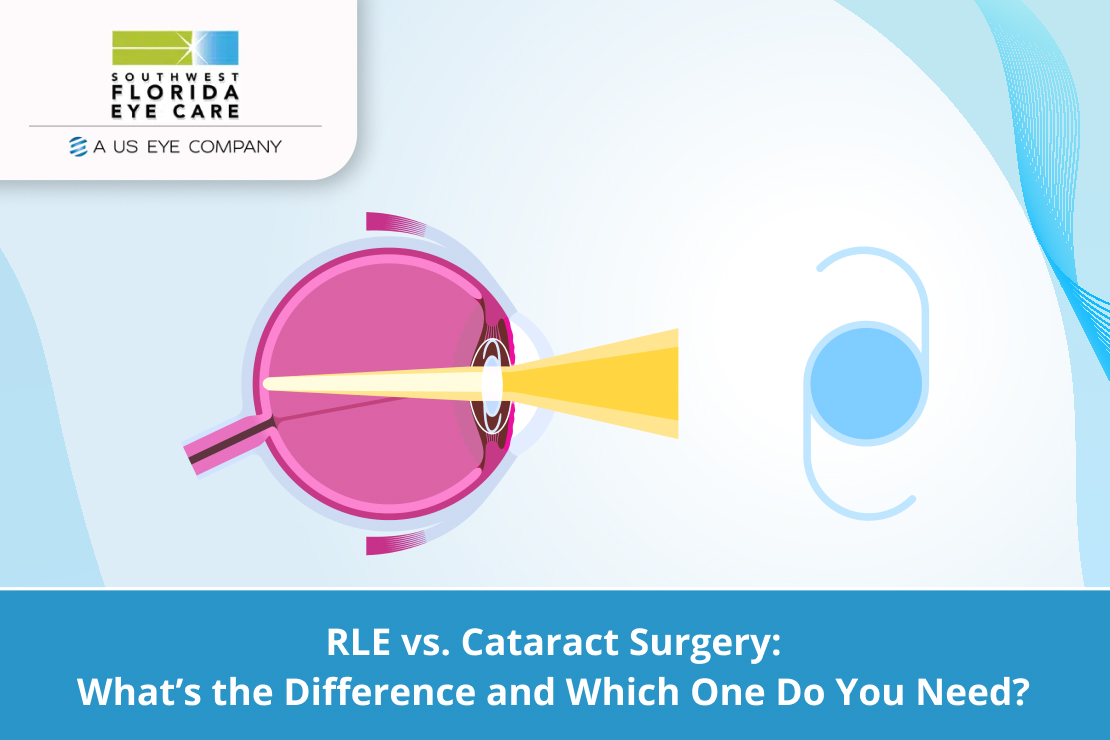
An ophthalmologist replaces your natural lens with an artificial intraocular lens (IOL) customized to correct your specific refractive errors (nearsightedness, farsightedness, astigmatism, or presbyopia). The procedure takes about 15 minutes per eye, and you can often see clearly within a few days.
Who Qualifies for RLE?
- Ages 40+
- Stable vision, no active eye disease
- Desire for permanent correction without glasses or contacts
- Not already diagnosed with cataracts
Bonus Benefit: Since RLE replaces your natural lens with a synthetic one, you’ll never develop cataracts in the future.
However, it’s important to know that RLE doesn’t eliminate the risk of other age-related eye conditions, and, like any surgery, it carries some risk, including infection or retinal complications.
What Is Cataract Surgery?
Cataract surgery is a medically necessary procedure for patients with cloudy or blurred vision due to cataracts.
Cataracts form when the natural lens becomes hard and yellowed, which affects how light passes through the eye. This leads to:
- Blurred or dim vision
- Sensitivity to light
- Difficulty seeing at night
- Colors looking faded or yellow
How Cataract Surgery Works?
Just like RLE, your surgeon removes the natural lens and replaces it with an IOL. The key difference is why you’re getting the surgery — to restore lost vision, not to electively improve it.
Read More: How Does Cataract Surgery Work
Who Needs Cataract Surgery?
- Diagnosed with cataracts
- Vision impacts daily activities
- Trouble seeing clearly, even with glasses
- Double vision, faded colors, or night-driving issues
The Core Similarity: Same Procedure, Different Purpose
Here’s where things get interesting. RLE and cataract surgery use the same technique.
- In both surgeries, the cloudy or aging lens is replaced with a synthetic intraocular lens (IOL).
- The surgical method, tools, and recovery time are nearly identical.
- Both are performed in about 15 minutes per eye.
- Both offer long-term vision improvement.
So, what sets them apart?
RLE vs. Cataract Surgery: What’s the Real Difference?
Refractive Lens Exchange (RLE) Cataract Surgery Purpose Elective vision improvement Medically necessary to treat cataracts Cataract Coverage Prevents future cataracts Removes existing cataracts Not covered (considered elective) Covered by insurance/Medicare for basic care Lens Options All IOL types available; premium cost applies Basic monofocal covered; premium at extra cost Notes on Lenses Ideal for customizing vision correction Advanced lenses improve outcomes, not covered.
If you’re looking to enhance your vision now and avoid cataracts later, RLE is the solution. However, if your vision is already compromised by cloudiness or cataracts, cataract surgery is the necessary medical step.
| Feature | Refractive Lens Exchange (RLE) | Cataract Surgery |
| Primary Purpose | Elective vision correction | Medically necessary to restore vision |
| When It’s Performed | Before cataracts develop | After cataracts impair vision |
| Lens Condition | Clear but aging lens | Cloudy, cataract-affected lens |
| Goal of Surgery | Reduce or eliminate the need for glasses | Restore lost vision clarity |
| Insurance Coverage | Not covered (elective) | Typically covered by insurance/Medicare |
| Lens Options | Full range of premium IOLs available | Basic lens covered, premium upgrades optional |
| Long-Term Benefit | Prevents future cataracts | Removes existing cataracts |
Both procedures use nearly identical surgical techniques, but RLE eye surgery is performed proactively, while cataract surgery is reactive—addressing vision that has already deteriorated.
Your Lens Choices: Types of Synthetic Lenses Used
Both RLE and cataract surgery rely on artificial lenses known as intraocular lenses (IOLs), but there are several types available, each designed for different visual needs and lifestyles.
Here’s a quick breakdown of your options:
- Monofocal Lenses: Focus at one distance (usually far). Standard option, insurance-covered for cataracts.
- Monofocal Plus Lenses: Similar to monofocal, but with slightly improved intermediate vision.
- Multifocal Lenses: Offer correction for both near and far vision. Great for reducing glasses dependency.
- Trifocal Lenses: Cover near, intermediate, and distance vision — ideal for active lifestyles.
- EDOF Lenses (Extended Depth of Focus): Provide a continuous range of focus, reducing halos and glare.
- Toric Lenses: Correct astigmatism for sharper vision.
- Accommodative Lenses: Shift focus like a natural lens by responding to eye muscle movements.
- Light-Adjustable Lenses (LAL): These lenses can be fine-tuned after surgery for precise vision correction.
- Advanced Technology Lenses: A catch-all term for newer, premium lenses offering enhanced functionality.
- Monovision Strategy: Uses different lenses in each eye (one for near, one for distance).
- Implantable Contact Lenses: Sometimes used for patients not suitable for other types of correction, though not typical in RLE or cataract surgery.
Choosing the right lens depends on your vision goals, lifestyle, and whether your procedure is elective (RLE) or medically necessary (cataracts). Your surgeon will help match the right lens to your eyes.
Read More: Types of Optical Lenses
Which One Should You Get — RLE or Cataract Surgery?
It depends on where you are in your vision journey.
You may benefit from RLE if:
- You’re over 40
- You have age-related vision changes
- You want to reduce or eliminate glasses
- You don’t yet have cataracts
- You want to correct multiple vision issues at once
You may need Cataract Surgery if:
- You have cloudy or blurry vision
- Glasses aren’t helping anymore
- You’ve been diagnosed with cataracts
- Your vision is affecting your work, driving, or daily life
Still unsure? Start with a full eye exam. A qualified eye specialist can evaluate your lenses, measure your prescription, and assess whether early cataract changes have begun.
Need help finding the right doctor? This guide can help.

Tips to Choose the Right Surgery for You
Deciding between RLE and cataract surgery isn’t just about age or symptoms — it’s about your ocular health, lifestyle goals, and vision priorities.
Here’s what to consider when weighing your options:
- Detailed Consultation: A full eye exam with biometric testing will reveal whether you’re a candidate for RLE or if cataracts are already forming.
- Lens Choices: Whether you need a monofocal lens or a presbyopic lens implant (such as a multifocal or toric lens), your lifestyle plays a key role in selection.
- Tailored Treatment Plans: Every eye is different. Your surgeon will recommend a plan that fits your daily habits, eye shape, and vision expectations.
- Informed Consent Process: You’ll review the benefits, risks, and the likelihood of needing secondary corrections or enhancement surgery later.
- Lifestyle Considerations: Do you drive at night often? Work at a computer all day? Travel frequently? These influence what outcome you’ll be happiest with.
- Refractive Expectations: Be honest about what you want. Some patients want perfect vision without glasses — others just want to drive safely at night.
- Surgical Outcome & Follow-Up: Recovery is typically quick, but results depend on the lens, your eye health, and adherence to post-op care.
Bottom line: the best choice is the one that aligns with your current vision status and your future lifestyle goals.
How Is Surgical Planning Different for RLE vs Cataract Surgery?
Surgical planning plays a critical role in achieving the best visual outcome, especially when comparing RLE vs cataract surgery. While both procedures involve replacing the natural lens, the planning process differs based on whether the goal is vision enhancement or vision restoration. Understanding refractive lens exchange vs cataract surgery at this stage helps ensure the right lens and approach are selected for each patient.
Planning for RLE (Elective Vision Optimization)
With RLE eye surgery, the focus is on achieving the highest possible visual performance based on your lifestyle.
Key considerations include:
- Lifestyle-driven vision goals – Your daily activities play a major role in planning. For example, patients who frequently use screens may prioritize intermediate vision, while those who drive at night may need lenses that minimize glare and halos.
- Advanced intraocular lens (IOL) selection – Options such as multifocal, trifocal, toric, and EDOF lenses are chosen based on your specific refractive errors (nearsightedness, farsightedness, astigmatism) and desired level of spectacle independence.
- Level of glasses independence desired – Some patients aim to eliminate glasses, while others are comfortable using them occasionally. This expectation directly influences lens choice and surgical strategy.
- Precision biometric measurements and diagnostics – Detailed eye measurements—including corneal curvature, axial length, and lens calculations—are used to customize the procedure and improve the accuracy of visual outcomes.
- Future vision stability and prevention strategy – Since RLE replaces the natural lens, it eliminates the possibility of developing cataracts later, making it a proactive long-term vision solution.
Because RLE is elective, patients often have more flexibility in choosing advanced lens technologies.
Planning for Cataract Surgery (Medical Necessity)
Cataract surgery planning focuses first on restoring clear vision and then on optimizing results.
Key considerations include:
- Severity of cataract: Determines urgency and surgical timing
- Insurance coverage: May influence lens options
- Functional vision needs: Driving, reading, and daily tasks
- Lens upgrades: Optional premium lenses for improved outcomes
In cataract cases, restoring clarity is the priority, but patients can still enhance results with advanced lens options.
How to Decide and Take the Next Step
It’s one thing to read about these procedures, but it’s another to know what your own eyes actually need.
That’s why your next step should be a consultation with a trusted eye care provider. They’ll answer key questions like:
- Do you already have early-stage cataracts?
- Is your prescription stable?
- What lens options fit your lifestyle?
- Can your insurance help with part of the cost?
Whether you’re planning ahead with RLE or need to act now with cataract surgery, having a professional guide makes the process faster and easier.
Still Wondering Which Surgery Is Right for You?
We know that deciding between RLE and cataract surgery can be confusing. That’s why our experienced eye care team is here to help. We offer clear answers, honest guidance, and expert care tailored to your needs.
Don’t wait for your vision to get worse. Let’s make a plan together.
Contact Us Today to book your consultation and take the first step toward sharper, clearer sight.
**Disclaimer: The advice in this blog is for general informational purposes only and may not be suited for your exact insurance plan and retinal needs. Therefore, consulting a qualified healthcare professional for personalized advice and treatment is essential.**
Frequently Asked Questions
What is the difference between refractive lens exchange (RLE) and cataract surgery?
RLE is done to correct vision before cataracts form; cataract surgery treats vision loss from existing cataracts.
When is RLE recommended instead of cataract surgery?
RLE is recommended for adults over 40 who want vision correction and don’t yet have cataracts.
Does RLE prevent cataracts?
Yes. Replacing your natural lens with an artificial one means cataracts can’t develop in that eye.
What are the risks of RLE surgery?
Risks include infection, retinal detachment, glare, or halos, but these issues are uncommon.
What vision outcomes are expected after RLE?
Most people see more clearly and rely less on glasses, especially with advanced lens options.