A cataract surgery consultation is a comprehensive medical evaluation designed to determine whether surgery is appropriate, how it should be performed, and which visual outcomes are realistically achievable for the individual patient. This visit includes a detailed review of medical and ocular history, advanced diagnostic testing, assessment of cataract severity, and an in-depth discussion of surgical options, including intraocular lens selection and the potential role of laser-assisted techniques. The consultation serves as the foundation for safe surgical planning and informed decision-making.
Patients who understand what to expect at a cataract surgery consultation and arrive prepared with relevant questions are better equipped to participate in shared decision-making with their surgeon. By using a structured cataract consultation checklist and discussing risks, recovery, lens options, and cost considerations in advance, patients can approach cataract surgery with clarity, confidence, and realistic expectations regarding visual outcomes.
If cataracts have begun to affect your vision, how can you be certain that surgery is necessary, appropriate, and tailored to your individual eye health?
Cataract surgery is one of the most frequently performed surgical procedures in the United States and is widely recognized for its safety and effectiveness. According to the National Eye Institute (NEI), cataracts affect more than 24 million Americans aged 40 and older, and that number continues to rise as the population ages. Despite its prevalence, cataract surgery should never be approached as a routine or rushed decision.
A cataract surgery consultation is a comprehensive medical evaluation designed to determine whether surgery is indicated, how it should be performed, and which visual outcomes are realistically achievable. Understanding what to expect during cataract surgery consultation appointments helps patients make informed decisions grounded in clinical evidence rather than assumptions.
By preparing a structured list of cataract surgery consultation questions and following a detailed cataract consultation checklist, patients can actively participate in their care while ensuring that all clinical, surgical, and lifestyle considerations are addressed.
Step-By-Step Overview Of A Full Cataract Consultation
A complete cataract consultation is a structured, multi-step process. It evaluates both the severity of the cataract and the overall health of the eye. Unlike a standard vision exam, this visit focuses on surgical planning, risk assessment, and patient education.
Patients often ask what to expect at cataract surgery consultation visits. While specific protocols may vary slightly between institutions, the core elements are consistent across high-quality ophthalmology practices.
Patients often ask what to expect at cataract surgery consultation visits. While specific protocols may vary slightly between institutions, the core elements are consistent across high-quality ophthalmology practices.
Medical And Vision History Evaluation
The consultation begins with a thorough review of medical and ocular history. This step is essential for identifying factors that may influence surgical timing, technique, or outcomes.
The surgeon or clinical team will review:
- Current visual symptoms and functional limitations
- Progression of cataract-related vision changes
- History of eye disease, trauma, or prior eye surgery
- Systemic medical conditions such as diabetes or cardiovascular disease
- Current medications, including blood thinners
The Centers for Disease Control and Prevention (CDC) notes that systemic conditions such as diabetes can increase the risk of eye complications, making a comprehensive history review a critical safety measure.
An experienced cataract surgeon in Fort Myers or Naples, Florida, or anywhere near you, uses this information to determine surgical readiness and identify any additional precautions that may be required.
Diagnostic Testing And Ocular Measurements
After the history review, patients undergo advanced diagnostic testing. These tests provide objective data needed to confirm the diagnosis and plan surgery with precision.
Standard diagnostic evaluations include:
- Best-corrected visual acuity testing
- Intraocular pressure measurement
- Slit-lamp examination of the lens
- Corneal topography
- Optical biometry to measure eye length
- Retinal examination
Accurate measurements are essential for calculating intraocular lens power and for choosing lens implants and cataract surgery options. According to a study, precise biometric measurements are a key determinant of postoperative visual accuracy.
Understanding what to expect at a cataract surgery consultation and testing reassures patients that these evaluations are evidence-based and clinically necessary.
Evaluation Of Cataract Severity And Surgical Indication
Not all cataracts require immediate surgery. During the consultation, the surgeon evaluates whether the cataract is significantly impairing vision or quality of life.
The NEI emphasizes that cataract surgery is generally recommended when vision loss interferes with daily activities such as driving, reading, or work tasks. This determination is based on both clinical findings and patient-reported symptoms.
This discussion forms the basis for many important questions in cataract surgery consultations, including whether delaying surgery is medically reasonable.
Intraocular Lens Options And Vision Correction Goals
One of the most critical components of the consultation is the discussion of lens replacement options. Cataract surgery permanently replaces the natural lens, making the decision to choose lens implants a long-term one.
The surgeon explains available lens categories, including:
- Monofocal lenses for single-distance clarity
- Toric lenses for astigmatism correction
- Multifocal and extended depth-of-focus lenses are designed to reduce spectacle dependence
The AAO notes that premium lens technologies can improve functional vision for selected patients but may not be suitable for everyone.
A skilled cataract surgeon in Fort Myers and Naples, FL, or anywhere near you, helps patients align lens choice with realistic visual goals, occupational needs, and ocular health factors.
Key Cataract Surgery Consultation Questions To Ask
Active patient participation improves satisfaction and outcomes. A written cataract consultation checklist ensures all essential topics are addressed.
Important cataract surgery consultation questions include:
- Is cataract surgery medically indicated at this time?
- What type of cataract do I have?
- Am I a candidate for laser cataract surgery?
- What visual results can I realistically expect?
- What risks apply to my specific eye health?
- What is the recovery timeline?
- How many cataract procedures do you perform annually?
These questions support informed consent and shared decision-making.
Surgical Risks And Recovery Expectations
Cataract surgery has a high success rate, but patients must understand potential risks. The NEI reports that serious complications are uncommon but may include infection, inflammation, or retinal issues.
During the consultation, the surgeon explains:
- Surgical safety protocols
- Risk mitigation strategies
- Expected postoperative symptoms
- Follow-up care schedule
Understanding what to expect at cataract surgery consultation discussions regarding recovery allows patients to plan appropriately.
Laser-Assisted Cataract Surgery Considerations
Laser-assisted cataract surgery, also known as femtosecond laser–assisted cataract surgery (FLACS), represents an advanced surgical option that may be discussed during a comprehensive cataract surgery consultation. Unlike conventional cataract surgery, which relies entirely on handheld surgical instruments, laser-assisted techniques use computer-guided laser technology to perform select steps of the procedure with a high degree of precision.
During the consultation, the surgeon evaluates whether laser technology may offer clinical advantages based on the patient’s ocular anatomy, refractive goals, and overall eye health. Understanding what to expect at cataract surgery consultation discussions regarding laser technology allows patients to make evidence-based decisions rather than assuming it is universally superior.
How Laser Cataract Surgery Differs From Conventional Surgery
In laser-assisted cataract surgery, a femtosecond laser is used to perform specific steps that are traditionally done manually. These steps may include:
- Creating corneal incisions
- Opening the lens capsule (capsulotomy)
- Softening the cataract for removal
The laser uses detailed three-dimensional imaging of the eye, allowing the surgeon to plan and execute these steps with high reproducibility. According to the American Academy of Ophthalmology (AAO), laser assistance can improve consistency in specific surgical steps but does not replace the surgeon’s expertise or judgment.
Which Patients May Benefit Most From Laser Assistance
Laser cataract surgery is not necessary for every patient. During the consultation, the surgeon assesses whether the technology provides measurable benefit for the individual patient. Candidates who may benefit include those with:
- Astigmatism requiring precise corneal incisions
- Dense or advanced cataracts
- Irregular corneal anatomy
- Desire for premium intraocular lens accuracy
This evaluation is a key part of the cataract surgery consultation questions and should be addressed directly. A qualified cataract surgeon will explain whether laser assistance meaningfully improves surgical precision for the patient’s specific eye measurements.
Preparing for the consultation and surgery
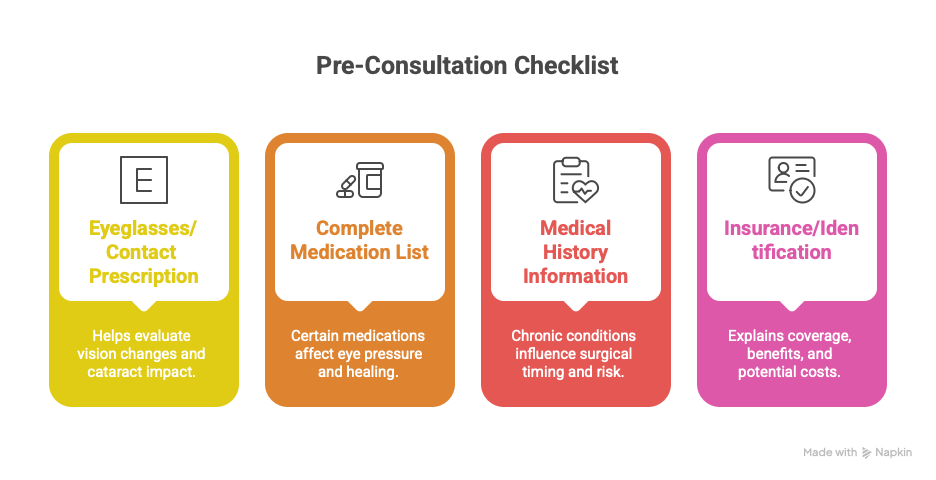
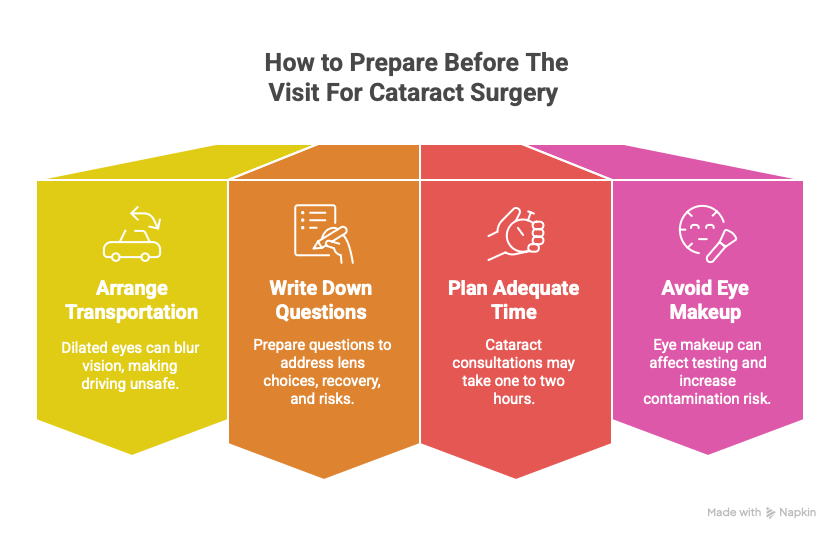
Adequate preparation for cataract eye surgery begins at the consultation stage. Preparation improves efficiency, understanding, and outcomes.
Recommended preparation steps include:
- Bringing a complete medication list
- Bringing current eyewear
- Arranging transportation
- Preparing written cataract surgery consultation questions
- Reviewing a cataract consultation checklist
Proper preparation for cataract eye surgery ensures that medical decisions are based on accurate information.

Conclusion: Making Informed Decisions Before Cataract Surgery
A cataract surgery consultation is the foundation of safe, effective treatment. By understanding what to expect at cataract surgery consultation visits, preparing a structured cataract consultation checklist, and asking informed cataract surgery consultation questions, patients actively participate in evidence-based care.
From choosing lens implants and cataract surgery options to preparing for cataract eye surgery, each step contributes to long-term visual health. With guidance from an experienced cataract surgeon, patients can proceed with confidence.
Selecting a qualified surgeon is a critical factor in surgical success. Patients seeking a trusted cataract surgeon in Fort Myers or Naples, Florida, benefit from Southwest Florida Eye Care’s experience with advanced technology, regional continuity of care, and long-term follow-up.
For individuals seeking comprehensive evaluation, advanced laser cataract surgery, and individualized care planning, contact us today and schedule an appointment.
Frequently Asked Questions
How long does a cataract surgery consultation take?
A typical cataract surgery consultation lasts between 1.5 to 3 hours. The duration depends on the complexity of your case and the number of diagnostic tests required. Expect to spend extra time if you need additional measurements or if your eyes require special evaluation. Plan your schedule accordingly and arrange for transportation, as your eyes may be dilated during the visit.
What should I bring to my cataract surgery consultation?
Bring the following to your appointment:
- A complete list of your current medications (including over-the-counter and supplements)
- Your current glasses or contact lenses
- Insurance card and identification
- A list of your symptoms and questions
- Any paperwork provided by your referring doctor
- A friend or family member to drive you home, as your vision may be temporarily affected by dilation drops
Will my eyes be dilated during the consultation, and can I drive afterward?
Yes, your eyes will almost always be dilated during the consultation to allow for a thorough examination of your lens and retina. Dilation can cause blurred vision and sensitivity to light for several hours, so it is strongly recommended that you arrange for someone to drive you home after your appointment.
How soon after the consultation can I have cataract surgery?
The time between your consultation and surgery can vary. In most cases, surgery is scheduled within 2 to 6 weeks after your initial evaluation, depending on your medical readiness, the surgeon’s schedule, and any necessary preoperative clearances from your primary care physician or specialists.
What happens if I wear contact lenses? Should I stop wearing them before my consultation?
Contact lenses can alter the shape of your cornea, potentially affecting measurement accuracy. Most eye surgeons recommend discontinuing soft contact lenses at least 2 weeks before your consultation and hard or rigid gas permeable lenses for up to 8–12 weeks prior. Confirm specific instructions with your eye care provider before your appointment to ensure the most accurate testing and optimal surgical planning.